The average UK living room is 17.09 square metres, according to data from the RICS. For flats in London and other major cities, it is frequently smaller. This means that the vast majority of living rooms in Britain have to work extremely hard to accommodate seating, storage, entertainment equipment, and whatever else daily life requires — without feeling cramped.
The good news is that the perception of space is, to a large degree, controllable. Many of the most effective changes cost very little and require no building work.
Furniture Placement Before Furniture Shopping
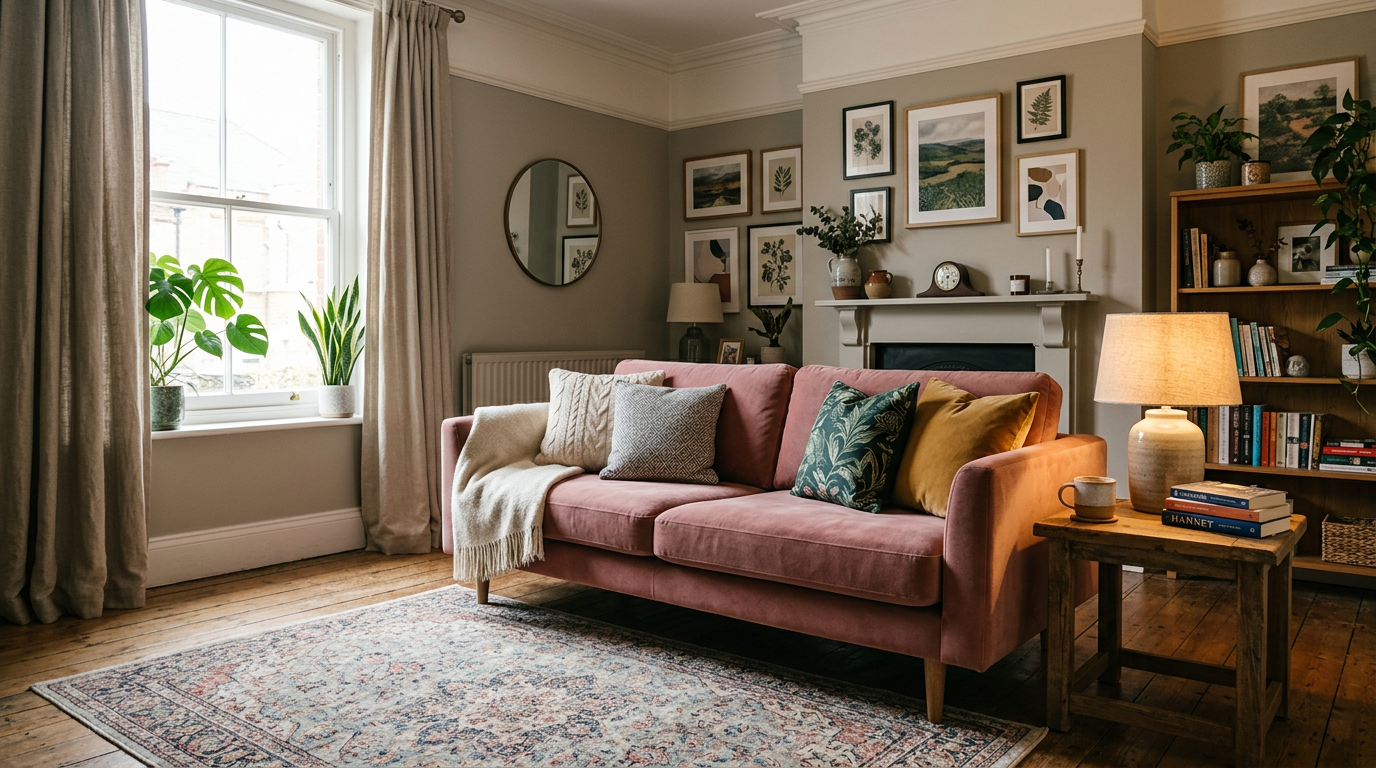
The most common mistake in small living rooms is the instinct to push all furniture against the walls. This is counter-intuitive, but a sofa pulled 20–30 cm away from the wall typically makes a room feel larger, not smaller. It creates a sense that the room has depth, rather than a perimeter of stuff with empty floor in the middle.
The second principle is scale: a single large sofa generally looks better in a small room than two smaller sofas or a sofa-and-armchair combination. One cohesive piece reads as intentional; multiple smaller pieces can feel cluttered. If seating for more people is needed, a single elegant chair that can be moved from elsewhere in the home serves the purpose without permanently occupying valuable floor space.
Mirrors and Natural Light
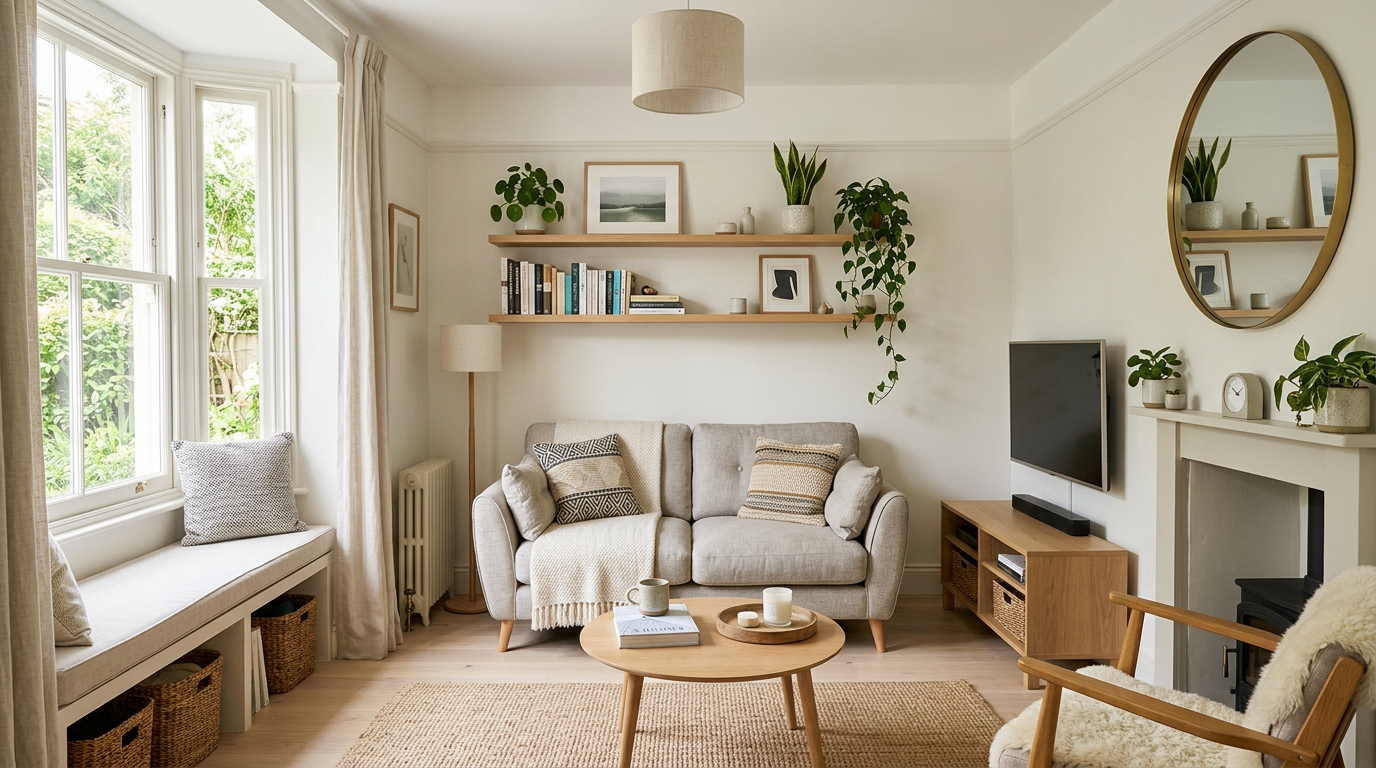
A large mirror placed opposite or adjacent to the main window is one of the most effective and low-cost interventions available. It reflects the light source and creates the visual impression of a second window — or, in the case of a floor-to-ceiling mirror, of a second room. This works best when the mirror reflects something attractive: natural light, a plant, or an open doorway rather than a wall of furniture.
Window treatments have a significant effect that is often underestimated. Curtains hung at ceiling height and extending beyond the window frame on either side make windows appear larger and draw the eye upward, creating the impression of a taller, more spacious room. Sheer fabrics maintain privacy while maximising the amount of light that enters the space.
Vertical Space and Floating Shelves
Small rooms frequently have unused vertical space. Floating shelves taken close to ceiling height pull the eye upward and provide storage without occupying floor space. The key is restraint in what is placed on them — a shelf cluttered with miscellaneous objects adds visual noise; a shelf with books, a few plants, and deliberate gaps reads as design rather than storage.
The first thing I tell clients is to look up. Most rooms stop at eye level when it comes to how people use the space. Everything above that line is an opportunity — for storage, for interest, for making the room feel like it has more volume than it does.
Colour: Light Does Not Always Mean White
The conventional advice for small rooms is to paint them white or very light. This is not wrong, but it is also not the whole picture. A consistent colour palette — walls, ceiling, and woodwork in closely related tones — creates a seamless effect that minimises the visual interruption of corners and makes a room feel larger than distinct contrasts do. A very dark colour used consistently throughout a small room can have a similar expansive effect, by making the boundaries of the space harder to read.
What tends to reduce the apparent size of a room is contrast: white walls with dark architraves, or a brightly coloured feature wall against three plain ones. These draw attention to the edges of the room and make them feel closer.
Furniture That Works Twice
Multi-function furniture has a particularly strong return on investment in small rooms. An ottoman with internal storage replaces a coffee table and provides seating for guests. A sofa bed makes a living room into a guest room without a dedicated spare bedroom. Side tables that can be stacked or nested under one another take up almost no space when not in use.
The principle of choosing furniture that does more than one job — and that can be cleared away entirely when not needed — gives a small room the flexibility to feel different depending on how it is being used, rather than fixed in a single configuration.
Rugs and Zoning
A rug is one of the most effective tools for defining a seating area within a larger open space, but in a small room it serves a different purpose: it unifies the furniture into a cohesive group and anchors the space. The most common error is choosing a rug that is too small. In a small living room, a rug that extends at least to the front legs of all seating looks deliberate and spacious; a small rug in the centre of the room looks like a mistake.
Editorial note: This article is intended for general informational purposes. FireDesigners is an independent publication operated by Newsquest Media Group Limited.